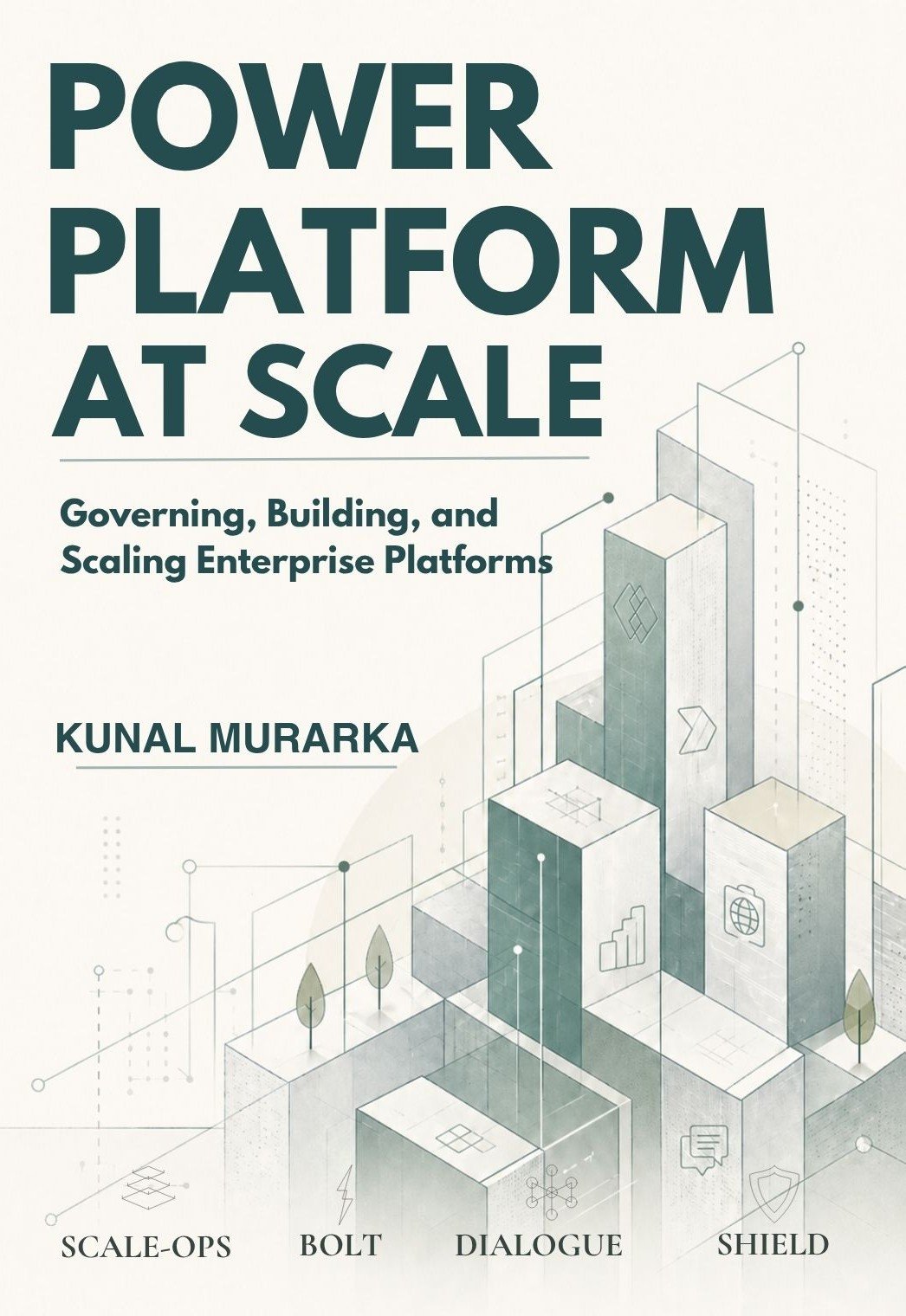
Power Platform at Scale — book cover
Power Platform
at Scale
Governing, Building, and
Scaling Enterprise Platforms
SCALE-OPS BOLT DIALOGUE SHIELD
Kunal Murarka
★★★★★ For platform practitioners everywhere
Paperback - ISBN 979-8-950260-00-1 · eBook - 979-8-950260-99-5
Available on Amazon
New Release · Cherry Press, 2026

Power Platform at Scale

Governing, Building, and Scaling Enterprise Platforms

The complete operating model for enterprise Power Platform — four integrated frameworks covering governance, delivery, solution design, and security.

Platform Administrators
Solution Architects
Enterprise IT Leaders

Most Platform and AI initiatives succeed as pilots — and demand a fundamentally different approach at scale.

The first few apps are easy. A form here, an automation there — business users are delighted, IT is supportive, and leadership sees quick wins. Then the platform grows. Environments sprawl. Security exceptions accumulate. Citizen developers build solutions no one can support. And what started as a productivity win becomes a governance liability.

Technology is only part of the answer. The rest lies in what surrounds it — governance, architecture, enablement, culture, and operating model that determine whether Power Platform becomes a strategic asset or an ungoverned shadow IT ecosystem.

This book closes that gap.

Who It's For

Written for the people who own the platform

Platform Administrators

Power Platform Administrators

You've been handed a growing platform with no playbook. Shadow IT is spreading, environments are multiplying, and governance requests are piling up. This book gives you the operating model you've been building in your head — formalized, battle-tested, and ready to implement.

Solution Architects

Solution Architects

You know how to build. The hard part is building right — across teams, compliance requirements, and delivery tiers that don't all move at the same speed. BOLT and DIALOGUE give you the decision frameworks to design solutions that scale without becoming someone else's maintenance nightmare.

Enterprise IT Leaders

Enterprise IT Leaders

Your organization has invested in Power Platform. Now you need governance that enables speed without creating risk. This book bridges the gap between IT control and business agility — with a complete operating model you can present to stakeholders and actually implement.

The Operating Model

Four Frameworks. One Operating Model.

Each framework addresses a different dimension of enterprise platform governance. They operate simultaneously — not sequentially.

SCALE-OPS Platform Operations Framework
How do we run the platform?

Eight dimensions for governing the platform at scale. SCALE-OPS is the anchor framework — everything else depends on having it in place.

S Stewardship — Accountability, mandate, and the governance board model
C Containment — Environments, DLP policies, and connector governance
A Automation — The CoE Starter Kit and platform self-governance
L Lifecycle — How solutions move from idea to retirement with ownership
E Enablement — Building and sustaining a healthy maker community
O Operations — Keeping the platform running and responding when it does not
P Performance — Measuring, communicating, and defending platform value
S2 Scalability — Designing the platform for tomorrow's scale, not today's
Part Two — Chapters 5–12 · Full Reference →
BOLT Delivery Framework
Who owns it, how is it delivered?

How business and IT build, own, and scale solutions together. Four delivery tiers determined by complexity, six roles defining who builds what and who is accountable.

B Business Ownership — Business teams lead delivery
O On-Demand Agility — Build without IT bottlenecks
L Low-Code Platform — Power Platform at every tier
T Trusted Enablement — IT as enabler, not gatekeeper
Part Three — Chapters 13–16 · Full Reference →
DIALOGUE Solution Design Framework
How do we build it well?

Seven building blocks every enterprise solution is composed of — with opinionated guidance on how each should be designed, reviewed, and governed.

D Data — The foundation — where information lives and who owns it
I Integration — Connectors, APIs, gateways, and authentication patterns
A AI — Governing AI Builder, Copilot Studio, and AI agents
L Logic — Where business rules live and why placement matters
O Operating Solutions — Monitoring, support tiers, and the post-go-live model
G Go-Live — Solution packaging, pipelines, UAT, and rollback governance
UE User Experience — Interface design, accessibility, and adoption outcomes
Part Four — Chapters 17–23 · Full Reference →
SHIELD Security Framework
How do we keep it secure?

Six pillars protecting the platform, its solutions, and the data they handle. Five pillars operate continuously. One — Inspect — fires as a risk-based gate before solutions reach production.

S Sight — Identity, access governance, and ongoing recertification
H Harden — Data classification, DLP design, and Dataverse security
I Inspect — Risk-based application security review before go-live
E Enforce — Policy documentation, audit logging, compliance evidence
L Lockdown — Environment isolation, network controls, and IP firewall
D Defend — Threat detection, incident response, and the feedback loop
Part Five — Chapters 24–29 · Full Reference →

Inside the Book

What You'll Walk Away With

Practical, implementable governance — not frameworks you read once and forget.

✓ GOVERNANCE

A complete operating model — not just principles, but the decisions, roles, and processes to implement it immediately.

✓ ENVIRONMENTS

Environment strategy and DLP policy patterns that balance maker enablement with enterprise control.

✓ DELIVERY

A delivery model that lets citizen developers move fast without creating solutions IT can't support or secure.

✓ SECURITY

Security architecture across all six SHIELD pillars — built for Power Platform's unique attack surface.

✓ SOLUTION DESIGN

Solution design standards that make cross-team collaboration consistent, governed, and auditable.

✓ TEMPLATES

Downloadable RACI matrices, governance checklists, decision guides, and a companion site with ongoing updates.

Resources

Ready-to-Use Governance Assets

All downloadable resources from the book appendices. PDFs hosted on GitHub for version tracking.

Companion Guide

Supplementary tools that extend the book — maturity assessments, decision tools, pre-production checklists, and quick-start guides.

Coming Soon
SCALE-OPS Maturity Assessment
Fillable assessment tool to evaluate your organisation's current governance maturity across all eight SCALE-OPS dimensions. Score, identify gaps, and prioritise.
Coming Soon
BOLT Delivery Tier Selector
Interactive decision tool to determine the correct BOLT delivery tier for a given solution based on complexity, data sensitivity, integration scope, and organisational risk appetite.
Coming Soon
SHIELD Pre-Production Checklist
Standalone security review checklist derived from the Chapter 36 scenario — Security Review Before Go-Live. Covers all six SHIELD pillars in a structured pre-production format.
Coming Soon
90-Day Quick-Start Guides
Dimension-by-dimension quick-start guides for the first 90 days of a governance programme. One guide per SCALE-OPS dimension with concrete actions, owners, and success criteria.

Practitioners

What Practitioners Are Saying

Reviews and testimonials coming soon.

Kunal Murarka — author of Power Platform at Scale

Kunal Murarka

Platform Governance Practitioner · Author · Thought Leader

Kunal Murarka has spent years helping enterprises govern, build, and scale Microsoft Power Platform deployments. He works at the intersection of IT governance, citizen development, and enterprise architecture — translating Microsoft's platform capabilities into operating models that actually work at scale. Power Platform at Scale is the book he wished existed when he started.

Updates & Errata

Keeping the Book Current

Microsoft product names, features, and licensing change. This tracks corrections, clarifications, and platform changes that affect the book's content.

2026-05-17
First edition published
Power Platform at Scale — first edition published by Cherry Press. ISBN 979-8-950260-00-1. All companion resources and downloadable templates will be published to this page as they become available.