“A city without governance is not a freer city. It is an uninhabitable one. The same is true of every enterprise platform.”
Most enterprise platform programmes start well. A small group of enthusiastic people builds impressive things quickly. Leadership gets excited. Adoption grows.
Then, at some point, the gap between what the platform can do and how the organisation is governing it becomes visible. A business-critical process needs an owner. A security review surfaces data flows that were never reviewed. The licensing bill arrives with numbers that are hard to explain.
The platform is capable. The operating model still needs to be built around it.
Before any framework, one analogy changes how people think about what governance actually is.
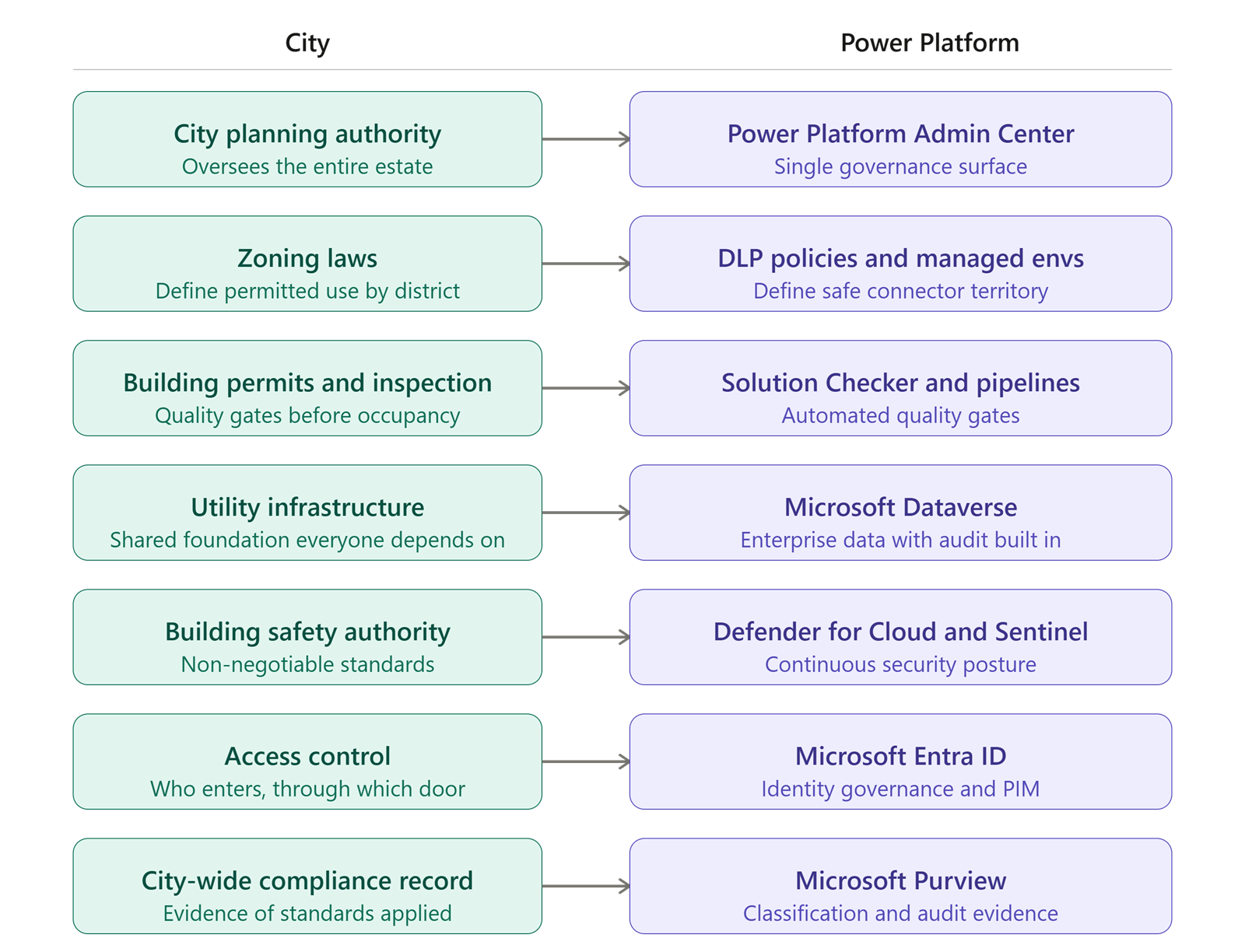
The Platform as a City
Think of an enterprise platform as a city.
The makers are its residents. The solutions they build are its buildings. The integrations, data flows, and security policies are the roads, utilities, and zoning laws.
Nobody builds roads twice. Everybody depends on them. And a city without roads, utilities, and zoning is not a freer city — it is an uninhabitable one.
Most organisations treat governance as a constraint on builders — something that slows things down. The city framing makes clear that governance is the infrastructure that makes building possible in the first place.
The organisations that move fastest on Power Platform are not the ones that govern least. They are the ones that govern deliberately — where makers understand the boundaries before they build, where pre-approved patterns mean a solution reaches production the same day it is ready, where security attention is on novel risks rather than repeatedly re-examining familiar patterns.
Safety in high-risk environments comes from systems, not from good intentions. Individual judgment at scale is not a governance model. It is a hope.
What Power Platform Provides
Microsoft has built the city infrastructure. The governance tooling exists across the entire ecosystem:
- Power Platform Admin Center — the single governance surface for every environment, app, flow, connector, and maker across the tenant
- Microsoft Purview — data classification, sensitivity labelling, and compliance evidence across every workload
- Microsoft Entra ID — identity governance, role-based access, and Privileged Identity Management for platform administration
- Microsoft Defender for Cloud — continuous security posture management across the estate
- Microsoft Sentinel — threat detection and security monitoring, including Power Platform-specific signals
- Data Loss Prevention policies and Managed Environments — zoning laws and district-level governance for environments handling sensitive or business-critical workloads
- Copilot Studio and AI Builder — governed AI agent deployment with documented accountability and action boundaries
The Microsoft ecosystem does not require a parallel governance infrastructure to be built beside it. It extends what the organisation already runs on. Every governance gap has a platform answer available today.
The Enterprise Gap
The tooling exists. The opportunity is to activate it as a coherent operating model.
Power Platform Admin Center surfaces everything. Data Loss Prevention policies define the boundaries. Managed Environments apply governance architecturally. The Centre of Enablement Starter Kit monitors the estate continuously.
Capability is not the same as readiness. The platform provides the former. The operating model must close the distance to the latter.
One Action
Open Power Platform Admin Center today. Answer three questions:
- Does every environment have a named, active owner?
- Does your Data Loss Prevention policy reflect your current data governance intent?
- Are your tenant-level settings in line with your enterprise policy standard?
If any of these takes more than ten minutes to answer, that is where the governance programme starts. Not with a framework. With three answers.
Part 1 of 36 | #PowerPlatformAtScale
The full operating model, city-to-platform framework mapping, maturity assessments, and decision guides are in the book.